
In Superset, SQL Is Not an Escape Hatch
Most BI tools hide SQL because they assume analysts would rather not write queries. Apache Superset makes the opposite bet — and that decision makes traceability possible.
Picture an analyst who opens a BI tool, builds a chart, and publishes a dashboard. Three weeks later, a stakeholder asks why one metric has changed. The analyst opens the dashboard. The chart looks right. She clicks through to find the underlying query. There isn't one — not visibly, anyway. The chart was built from a drag-and-drop interface that generated something, somewhere, that produced these numbers. She files a ticket with the data team. The data team spends an afternoon reconstructing what the chart was actually measuring.
This is not a story about bad tooling. It is a story about what BI tools optimize for. Most of them optimize for the shortest path from "I want a chart" to "I have a chart." SQL is treated as friction. The goal is to abstract it away so that analysts don't have to write queries.
Apache Superset makes the opposite bet.
The Superset difference: SQL Lab is not an escape hatch for power users. It is the intended starting point. That decision makes every artifact in the workspace — datasets, charts, dashboards — traceable back to the question it was built to answer. Traceability is the feature. Everything else is downstream of it.
Most BI tools treat SQL as a problem to be solved
The logic is understandable. SQL is a barrier. Not everyone on a business team knows it. If you can replace the query with a GUI that produces the same result, you have made the tool accessible to more people.
What gets lost in that trade is context. A drag-and-drop chart builder produces a result. It does not produce a named, legible, auditable artifact that explains what was asked and how the answer was constructed. The chart works until it doesn't, and when it stops working, no one knows where to start.
There is also a deeper problem. When SQL is an escape hatch — something you use when the GUI can't handle your request — it becomes a second-class citizen. The workspace is designed around the GUI path. The SQL path is bolted on. Analysts who need precision end up in a workflow the product wasn't built for.
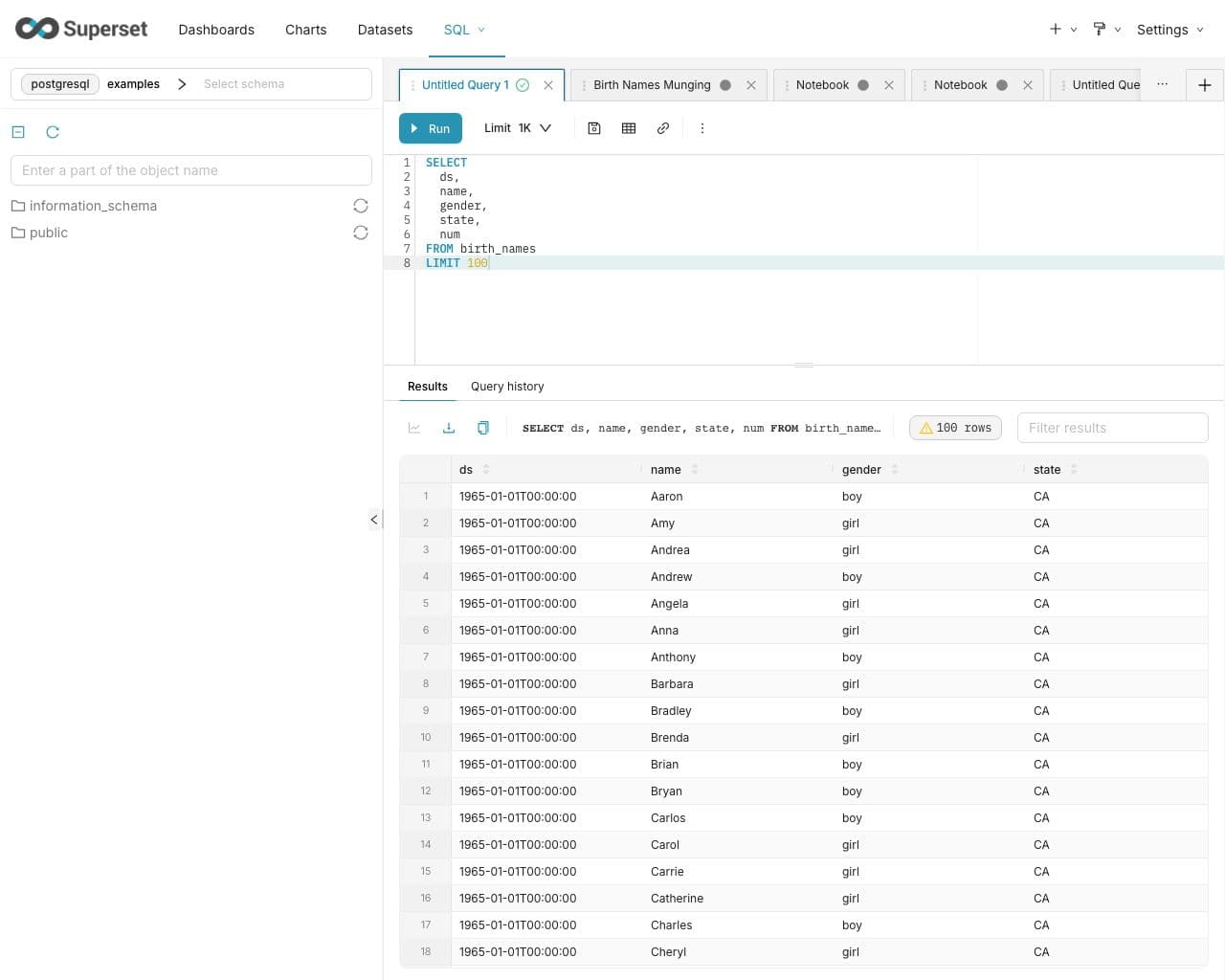
Superset inverts this. SQL Lab is where analysis begins. The product is designed around the assumption that analysts will write queries, and it gives them a proper environment to do it: multi-tab query editing, results inspection, query history, and the ability to save a query as a chart directly from the results view. The GUI chart builder exists and is useful, but it sits downstream of the SQL layer, not in front of it.
The chain from query to dashboard carries meaning
Here is what that looks like in practice. An analyst opens SQL Lab to investigate whether weekend conversion is declining in one region. She writes a query, inspects the results, refines the date window, and confirms the pattern is real. At that point, she can do two things: take a screenshot and move on, or promote the query to a dataset.
Promoting to a dataset gives the query a name. It becomes a reusable, documented definition — not just a piece of SQL floating in a tab. From that dataset, she builds a chart. The chart is linked to the dataset, which is linked to the query. She adds the chart to a dashboard. The dashboard is linked to the chart. Every step in that chain is visible.
When the stakeholder asks why the metric changed three weeks later, the investigation path is clear. Open the chart. Find the dataset. Read the SQL. The query is not hidden behind an abstraction layer. It is sitting there, legible, because it was always the thing doing the work.
This is not a luxury feature for sophisticated data teams. It is the minimum viable property for a BI workspace that people will trust over time. Numbers that cannot be traced back to their question are numbers that cannot be maintained.
Superset's open model is auditable, not just transparent
There is a separate argument for Superset that gets made in marketing copy — that being open-source means teams can inspect the code, avoid vendor lock-in, and reason about what the product is doing. That argument is true but incomplete.
The more practical benefit of Superset's openness is that its data model is legible. Datasets, charts, and dashboards are first-class objects with explicit relationships. You can look at a chart and find its dataset. You can look at a dataset and find its SQL definition. You can look at a dashboard and enumerate every chart it contains and trace each one back to its source.
Closed, proprietary BI tools often obscure these relationships — not maliciously, but because their architecture prioritized a smooth user experience over a legible object model. The cost appears later, when an organization needs to audit what its dashboards are measuring, migrate to a new data warehouse, or hand off a reporting system to a new team.
With Superset, that audit is possible. The relationships are explicit and the definitions are accessible. An organization that builds on Superset is building on something it can reason about — not a black box that produces dashboards.
Where the workflow breaks down, and what to do about it
Superset's architecture creates the conditions for traceability, but it does not enforce it. An analyst can still skip the dataset step and build a chart directly from an ad-hoc query. A dashboard can still accumulate charts from five different datasets with no documented relationship between them. The lineage is possible; it is not automatic.
This is where the surrounding workspace design matters. The question is not whether Superset supports traceability — it does — but whether the product experience makes traceability the natural path rather than the effortful one.
The natural path needs two things. First, SQL Lab should feel like the right place to start, not a detour. The exploration experience should be fast and low-ceremony, so analysts don't work around it. Second, the promotion step — from query to dataset to chart to published dashboard — should be the obvious next action at each stage, not something that requires navigating a settings panel.
When those two conditions are met, traceability happens as a byproduct of normal workflow. Analysts don't have to think about it. They write a query, build a chart, publish a dashboard, and the chain is already there.
VantumIQP is built around that path. SQL Lab is the entry point, not an advanced feature. Dataset promotion is a deliberate step that anchors every downstream artifact. Publication collects governance metadata at the moment the analyst has it — not retroactively. The goal is not to add traceability on top of a dashboard product. It is to make traceability the thing the product is made of, from the first query to the final published report.
Frequently Asked Questions
Does Apache Superset require analysts to know SQL?
No. Superset includes a chart builder that works without writing SQL — analysts can explore datasets through a visual interface. But SQL Lab is a first-class part of the product, not a power-user escape hatch. Teams that want to build precise, traceable datasets from real queries can do so directly, and those datasets carry that query context forward into every chart and dashboard built from them.
What is the difference between a Superset dataset and a direct query?
A Superset dataset is a named, reusable definition — often built from a SQL query — that becomes the source for one or more charts. When a chart is built from a dataset, it inherits the query logic and can be audited back to its source. A direct query in SQL Lab is exploratory and produces results without creating a persistent artifact. The workflow typically moves from SQL Lab investigation to dataset definition to chart to dashboard, preserving context at each step.
Why does traceability matter for BI dashboards?
When a metric shifts unexpectedly, someone has to find out why. If the chart links back to a named dataset, and the dataset links back to a SQL definition, that investigation takes minutes. If the chart is a one-off query disconnected from anything else, it can take hours — and sometimes the query is gone entirely. Traceability is not about audit compliance; it is about making the normal maintenance work of analytics fast instead of frustrating.
How does VantumIQP build on Superset's traceability?
VantumIQP keeps the Superset lineage model intact and organizes the workspace around it. Exploration happens in SQL Lab with no ceremony. Dataset promotion is a deliberate step. Publication collects the governance metadata — audience, purpose, source — at the moment when the analyst already has that context. The result is dashboards that stakeholders can trust and analysts can maintain without detective work.